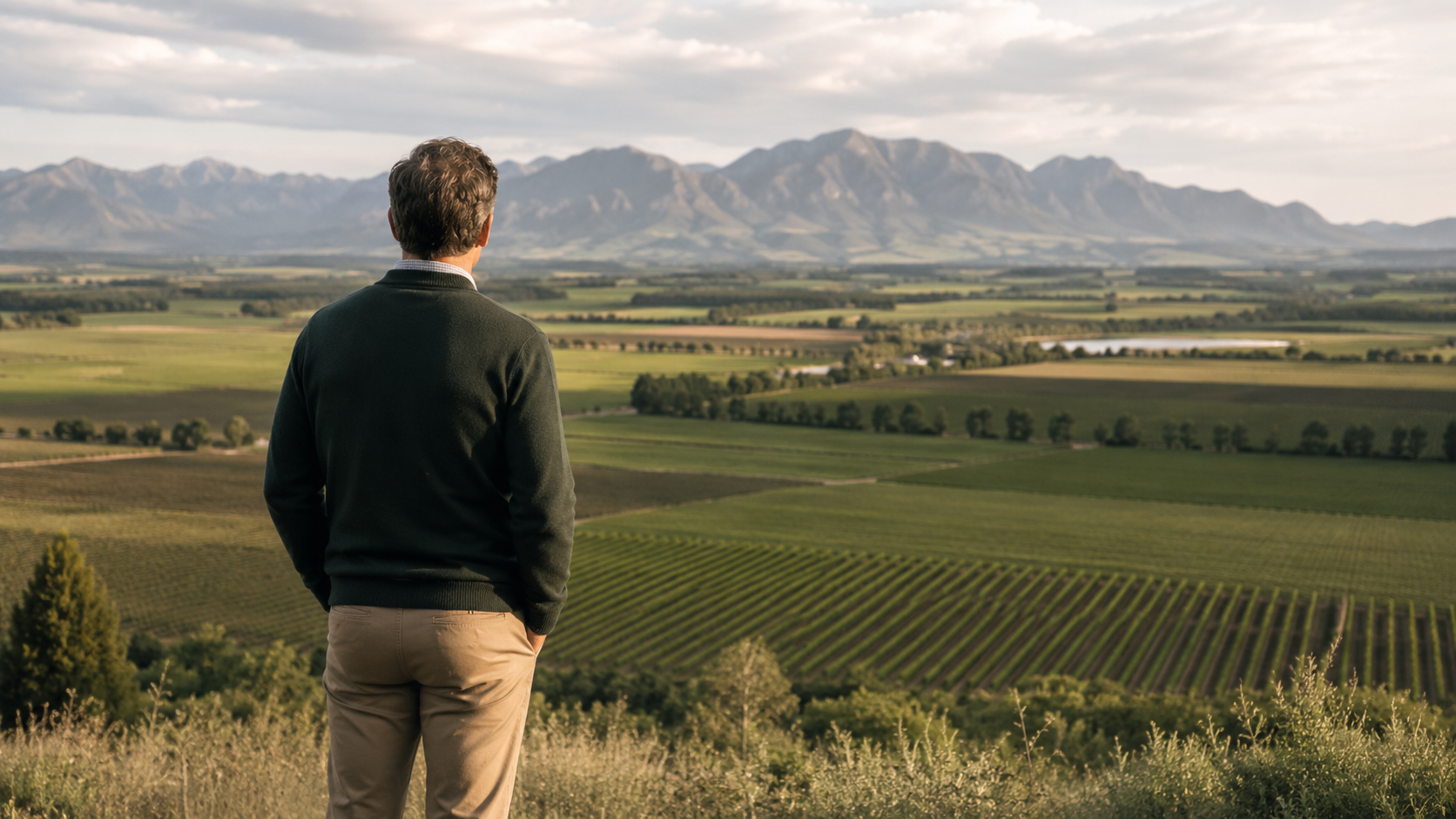
We Bought Agricultural Land. What Should We Do Next?
Disclaimer
Every agricultural asset is unique.
Land that appears attractive on paper may face limitations related to water availability, soil quality, climate, infrastructure, labor, market access, or legal structure. Likewise, successful agricultural projects depend on many factors beyond land ownership alone.
This article is intended to provide general guidance and should not be considered investment, legal, financial, tax, or agronomic advice. All agricultural investments should be evaluated individually and supported by appropriate technical, commercial, and legal due diligence before capital is committed.
Land that appears attractive on paper may face limitations related to water availability, soil quality, climate, infrastructure, labor, market access, or legal structure. Likewise, successful agricultural projects depend on many factors beyond land ownership alone.
This article is intended to provide general guidance and should not be considered investment, legal, financial, tax, or agronomic advice. All agricultural investments should be evaluated individually and supported by appropriate technical, commercial, and legal due diligence before capital is committed.
-------
Buying agricultural land is not the same as building an agricultural business. Land can look promising on paper. It can have road access, a good location, attractive surroundings, and a convincing story from the seller. But before deciding what to plant, an investor needs to answer a more practical question:
Can this land become an efficient agricultural asset?
The answer depends on inspection, not assumptions. In agricultural land investment, the first step is not choosing a crop. The first step is understanding what the land can realistically support — technically, commercially, financially, and operationally.
For an investor, five questions matter most:
- What is the size of the land plot, and is it efficient for the intended production model?
- Is there reliable access to water and irrigation?
- What does the market need — and is that demand sustainable?
- What do the climate, soil, and season allow us to grow?
- Is there enough human capital and room for future expansion?
These questions help turn land ownership into a real farm investment strategy.
Land Size and Irrigation: The First Two Questions in Agricultural Land Assessment
The first two questions in any agricultural land assessment should be simple:
- How many hectares are we working with?
- Do we have reliable access to water and irrigation?
These two factors immediately shape what the land can realistically become.
A small land plot may be suitable for a high-value crop, a trial project, a nursery, or a boutique production model. But it may not justify the cost of machinery, management, infrastructure, and professional agronomic supervision.
A larger land plot gives more flexibility. It can support mechanization, better labor planning, stronger bargaining power with buyers, and lower cost of production per kilogram. But it also requires more capital, stronger management, and clearer market access.
Water is even more critical. Without reliable water, many attractive production models become unrealistic. Intensive orchards, vineyards, berries, vegetables, and greenhouse production all depend on irrigation strategy.
The question is not simply whether water exists. The investor needs to understand:
- available water volume;
- water quality;
- legal access to water;
- seasonality of the water source;
- pumping costs;
- storage needs;
- filtration requirements;
- irrigation system design;
- future expansion potential.
A land plot without water may still have value. But it should not be planned as an intensive horticultural asset unless the water issue is solved first.
Practical Benchmark: Land Size, Machinery, and Production Efficiency
Land size should also be assessed through operational efficiency.
As a practical field benchmark, in orchards and vineyards, one tractor can often efficiently service up to 15 hectares for key mechanized operations, including work with labor teams, spraying and plant protection, and herbicide application (weed control).
For nut crops, this figure can be significantly higher — around 50 hectares per tractor on average, depending on planting system, terrain, machinery, and the level of mechanization.
For export-oriented agricultural production, the scale requirement is usually much larger. In many cases, a production base of around 300 hectares creates a stronger foundation for export strategy, buyer negotiations, logistics, sorting, storage, and stable supply.
These are not universal rules. They are inspection benchmarks. The exact figure depends on crop, terrain, row spacing, machinery type, labor availability, and harvest model. But they help the investor ask the right question:
Is this land large enough to be efficient for the production model we are considering?
Once we understand the size of the plot, we can estimate:
- potential planted area;
- number of trees, vines, or plants;
- expected yield per hectare;
- total production volume;
- machinery requirements;
- labor requirements;
- cost of production per kilogram;
- minimum commercial scale;
- investment logic.
This is where agricultural asset development becomes practical. We move from “What can we plant?” to “What volume can this asset produce, and will that volume be commercially meaningful?”
Market Before Crop: Demand Is Not Always a Strategy
The second major question is the market.
Many agricultural projects fail because the investor chooses a crop first and only later starts thinking about sales. This is the wrong order.
Before planting, the investor should understand:
- who will buy the product;
- what volume the market can absorb;
- what quality standards are required;
- what varieties are demanded;
- what packaging is expected;
- when the product should enter the market;
- whether the crop is for domestic sales or export;
- whether storage, sorting, cooling, certification, or processing will be required.
For developing countries, this distinction is especially important.
A crop that looks attractive on the domestic market may not meet export requirements. Export-oriented production usually needs stricter quality control, larger and more stable volumes, post-harvest infrastructure, certifications, traceability, packaging standards, and reliable logistics.
At the same time, export is not always better than domestic sales. Domestic markets can be more flexible, faster to access, and less demanding in terms of certification and packaging. But they may also have lower purchasing power, weaker price stability, and limited absorption capacity.
That is why market research should not simply ask, “Is there demand?”
It should ask:
What kind of demand exists, where is it located, how stable is it, and what production system is required to serve it profitably?
Hype Crops Can Be Dangerous
A product shortage on the market does not automatically mean that a crop is a good long-term investment.
Agriculture has long production cycles. By the time new orchards, vineyards, or plantations reach commercial production, the market may already have changed.
Almonds are a good example. For several years, almonds looked like one of the most attractive agricultural investments. Demand was growing, prices were strong, and many producers and investors expanded plantings. But when supply increased and demand slowed, the market changed. Prices dropped, profitability weakened, and some growers started removing orchards.
The lesson is simple:
A temporary shortage is not the same as sustainable demand.
For an investor, market research should separate three things:
- real structural demand;
- temporary shortage;
- hype created by high prices.
High prices can attract too many new producers. If many investors plant the same crop at the same time, future supply may exceed demand. This is especially risky for perennial crops, where production starts years after planting.
A good farm investment strategy should therefore include:
- current demand analysis;
- expected future supply;
- competitor planting trends;
- import and export dynamics;
- price history;
- buyer concentration;
- market window analysis;
- sensitivity to oversupply;
- realistic sales channels.
The key question is not only whether the market wants the product today.
The key question is:
Will the market still need this volume when our farm reaches full production?
Climate, Soil, and Season: What Can This Land Actually Grow?
After land size, water, and market come the biological questions.
Agriculture is local. A crop that performs well in one district may perform poorly 20 kilometers away because of frost pockets, soil structure, wind, humidity, disease pressure, slope, or water quality.
The technical assessment should include:
- length of the growing season;
- winter minimum temperatures;
- spring frost risk;
- summer heat stress;
- rainfall distribution;
- humidity and disease pressure;
- wind exposure;
- hail risk;
- soil texture and depth;
- soil pH and salinity;
- drainage;
- organic matter;
- carbonate level;
- slope and erosion risk;
- irrigation water quality.
These factors determine not only the crop, but also the variety, rootstock, planting density, irrigation system, trellis system, protection strategy, and harvest window.
For perennial crops, this is especially important. If an annual crop fails, the investor loses one season. If an orchard or vineyard is planted with the wrong variety or rootstock, the mistake can affect the asset for many years.
The output of this stage should be specific.
Not “apples may grow here.”
But: which apple varieties, on which rootstock, at what density, with what irrigation system, for which market window, and with what expected yield curve.
Not “grapes are possible.”
But: which grape type, which variety, which training system, what harvest period, what quality target, and what buyer profile.
This is where asset assessment turns into development planning.
Human Capital: What Do People in This Region Know How to Grow?
Agriculture is not only land, water, climate, and market. It is also people.
A production model that looks perfect in a spreadsheet can fail if the local team does not know how to manage it.
This is why human capital should be part of land inspection.
The investor should ask:
- What crops are traditionally grown in this region?
- What skills do local workers already have?
- Are there experienced tractor drivers, pruners, irrigators, sprayer operators, and farm managers?
- Do people understand the crop we want to plant?
- Are seasonal workers available during peak periods?
- Is there local knowledge of pests, diseases, pruning systems, irrigation, and harvest timing?
- Will the project require training or imported expertise?
This matters more than many investors expect.
For example, in a region where farmers have historically grown peaches, the local workforce may understand stone fruit pruning very well. But if the investor plants apples, the same workers may instinctively prune apple trees like peach trees. The result can be wrong tree architecture, lower yield potential, and years of correction.
This does not mean the investor should only plant what the region already knows. But if the chosen crop is new for the area, the project must include training, stronger supervision, and possibly external agronomic management.
Human capital is part of the investment model. If the knowledge is not available locally, it must be built or brought in.
Expansion Potential: Can the Agricultural Asset Grow?
The last question is expansion.
In agriculture, appetite often comes with eating. An investor may start with 10, 20, or 30 hectares and later realize that the business model only becomes truly efficient at a larger scale.
This is especially true when the project requires:
- specialized machinery;
- cold storage;
- sorting and packing;
- export certification;
- professional management;
- agronomic supervision;
- buyer contracts;
- logistics infrastructure;
- brand development.
Economy of scale works strongly in agriculture. As production volume grows, fixed costs can be spread across more kilograms. This can reduce cost of production per kilogram and improve competitiveness.
For example, a small orchard may need the same agronomist, tractor, sprayer, irrigation specialist, and management attention as a larger one. But the larger asset can distribute those costs across higher production volume.
This does not mean every investor should immediately develop hundreds of hectares. But the expansion question should be considered early:
- Is neighboring land available?
- Can water supply support future expansion?
- Can the road and electricity infrastructure handle growth?
- Can the labor pool support a larger farm?
- Can the market absorb higher volumes?
- Will future expansion reduce cost per kilogram?
- Is the current plot a standalone asset or only the first phase?
A good agricultural asset is not only productive today. It has a logical path for future development.
From Agricultural Land Investment to a Working Asset
After buying agricultural land, the investor should avoid rushing into planting.
The first step is inspection. The second step is development logic. The third step is investment planning.
A serious farm investment strategy should connect:
- land size;
- water and irrigation;
- market demand;
- domestic and export sales channels;
- climate and soil;
- crop and variety selection;
- human capital;
- machinery and labor efficiency;
- production volume;
- CAPEX;
- time to first revenue;
- expansion potential;
- governance and management.
Only when these elements fit together does land become an agricultural asset.
ATIS helps investors and landowners make this transition from land ownership to structured agricultural asset development. Through Advisory, Asset Assessment, Development Planning, and Investment Analysis, we help answer the questions that should come before planting:
- Is this land suitable for commercial agricultural development?
- What production models are realistic?
- Is the plot size efficient?
- Is water access sufficient?
- What does the domestic and export market need?
- Which crop and variety fit the land and the market?
- What human capital is available locally?
- What scale is needed for efficient production?
- What CAPEX and timeline should the investor expect?
Land can be valuable. But land with the right strategy can become a working agricultural asset.
FAQ: What to Do After Buying Agricultural Land
What is the first thing to do after buying agricultural land?
The first step is to inspect the land professionally. The most important starting questions are land size, water availability, irrigation potential, market access, climate, soil, labor availability, and expansion potential.
How do I decide what to plant on agricultural land?
Do not start with the crop. Start with land assessment and market research. The right crop should match the land’s size, water access, soil, climate, local skills, buyer demand, and expected production volume.
Why is water access so important in agricultural land investment?
Water determines whether intensive production is possible. Orchards, vineyards, berries, vegetables, and greenhouses all depend on reliable irrigation. Without secure water access, the investment strategy may need to change.
Is high market demand enough to choose a crop?
No. High demand can be temporary. Investors should check whether demand is structural or caused by short-term shortage, hype, or temporary price spikes. The key question is whether the market will still need the product when the farm reaches full production.
What is agricultural asset development?
Agricultural asset development is the process of turning land into a productive, commercially viable farm asset. It includes land assessment, market research, crop selection, CAPEX planning, production planning, management structure, and investment analysis.